
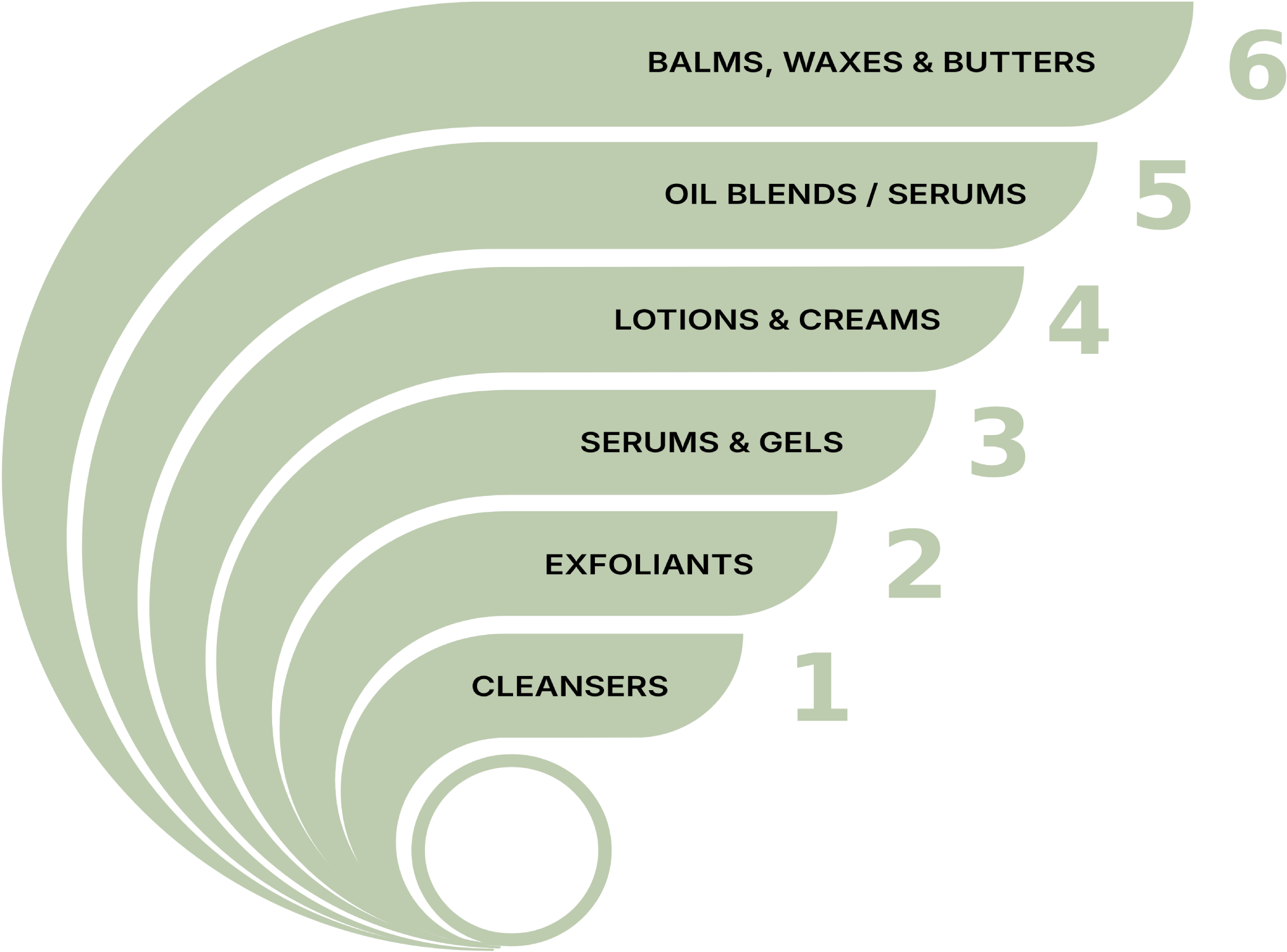
The order in which you apply skincare products directly affects how well they work. Proper layering helps products absorb effectively and ensures your skin gets the full benefit of each step.
The Timesaving Shortcut: You can actually mix certain products together! Water‑based serums, creams, and oils can be blended directly in your palm and applied as a single step. They’re listed separately below because if you choose to apply them individually, this is the skincare routine order that generally works best.
The following steps lay out general principles you can apply to any routine. If you want to make clean product formulas yourself, check out the customizable recipes in Simple DIY Skincare: The Complete Guide to Easy, Natural Recipes for Beginners.
In the morning, a single cleanse is usually enough. At night, double cleansing can help remove sunscreen, makeup, and excess oil:
Gentle exfoliation helps remove the outermost layer of dead skin cells, allowing active ingredients to penetrate more effectively. But don’t overdo it—those “dead” cells still play a protective role.
❌Avoid:
Serums deliver concentrated ingredients to target concerns such as dryness, dullness, or breakouts. Water‑based serums go first—they absorb best on clean, damp skin.
💡Mixing option: You can mix your water‑based serum with your cream or oil before applying.
Moisturizers nourish and protect the skin barrier. Choose based on your skin’s dryness level:
💡Mixing option: Creams and oils can be mixed with your water‑based serum in your palm and applied together as a single step.
These solid moisturizers form a breathable seal that locks in moisture and shields against irritants. Because balms stay on the skin longer, they’re perfect for targeted treatments.
Ideal for:
Sunscreen protects against UV damage, premature aging, and skin cancer. Apply a broad-spectrum sunscreen (SPF 30 or higher). While essential for everyone to prevent UV damage, choosing the right texture matters for your specific skin type:
⚠️The Truth About Powder Sunscreen: Brush-on mineral powders are a helpful, irritation-free option for sensitive, eczema-prone, and fungal-prone skin because they contain no oils, fragrances, or yeast-feeding lipids. However, do not rely on powder as your primary morning sunscreen. To actually get the SPF listed on the bottle, you would have to apply an unrealistically thick layer. Instead, apply a liquid sunscreen as your morning base, and use the powder throughout the day for easy touch-ups or to blot away excess shine.