
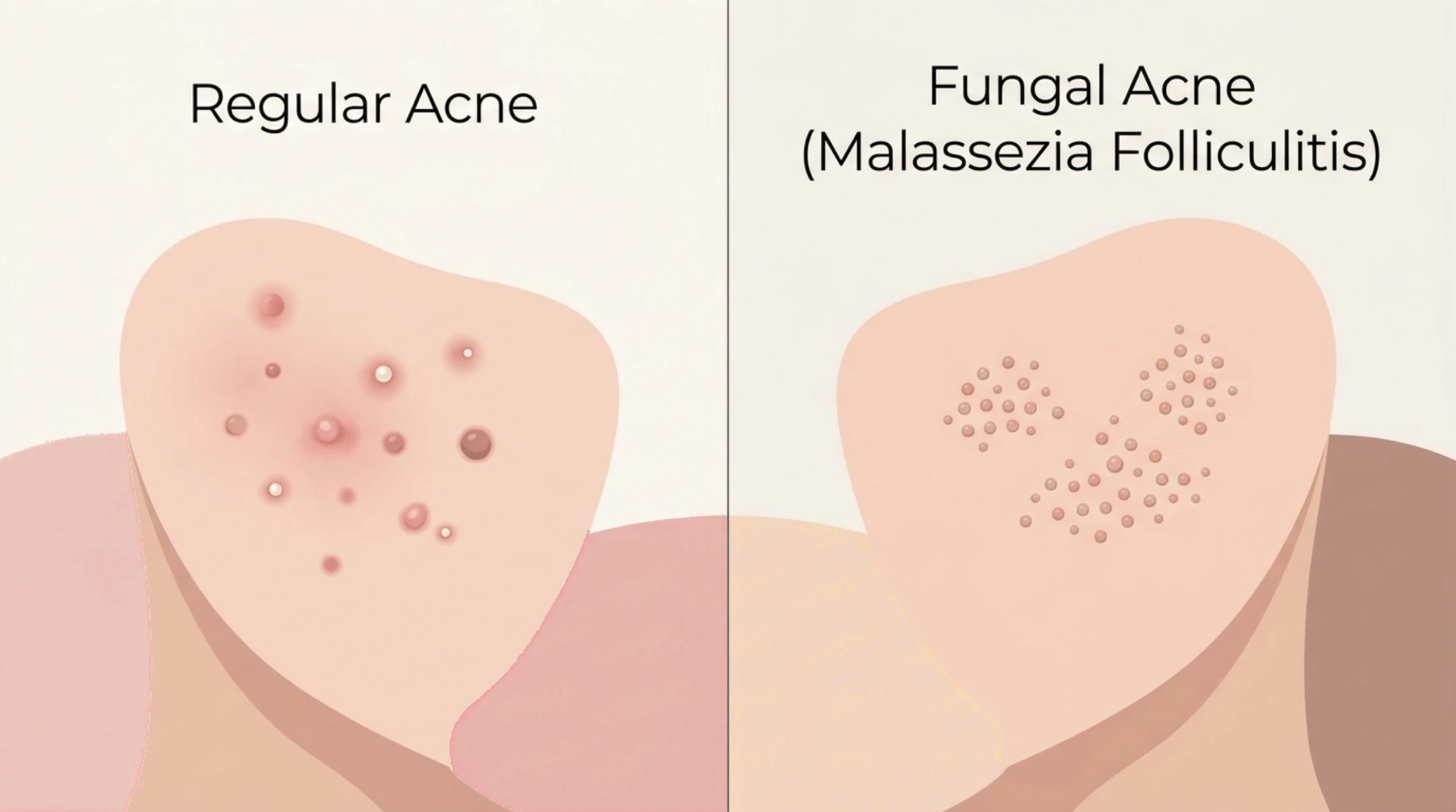
Understanding the difference between fungal acne (Malassezia folliculitis) and regular acne (acne vulgaris) is essential. Because they look incredibly similar, millions of people mistake one for the other.
The danger? Using standard acne products on a fungal breakout—especially rich plant oils or fatty acids—can cause the condition to persist for years. In rare cases, untreated fungal inflammation can lead to deeper skin issues like boils, scarring, or even hair loss.
To help you identify your breakouts quickly, here is a breakdown of how these two conditions differ in causes, symptoms, and locations.
| Feature | Fungal Acne (Malassezia) | Regular Acne (Acne Vulgaris) |
|---|---|---|
| Root Cause | Overgrowth of Malassezia yeast in hair follicles. | Cutibacterium acnes bacteria, excess sebum, and dead skin cells. |
| Appearance | Small, uniform red or white bumps that appear in clusters. | Mixed lesions: blackheads, whiteheads, deep nodules, or cysts. |
| Sensation | Often very itchy, especially when sweating. | Rarely itchy; usually painful or tender to the touch. |
| Common Areas | Moist or oily areas: forehead, hairline, chest, shoulders, back, arms. | Face (cheeks, jawline), upper back, and chest. |
| Oil Reaction | Worsens dramatically with plant oils and fatty acids. | Often improves with properly formulated nourishing plant oils. |
| Treatment | Starvation & Balance: Remove yeast food sources (plant oils/fatty acids) to let the microbiome normalize. Avoid over-using harsh antifungals. | Barrier Support & Balance: Focus on hydration and gentle, targeted actives. Avoid stripping or drying out the skin, which triggers a "rebound" oil flare-up. |
Before you try an at‑home experiment, consider that a few other skin issues can look almost identical to fungal acne but are not caused by fungal overgrowth.
Use this simple table to rule them out:
| Condition | What It Looks Like | What To Do Next |
|---|---|---|
| Steroid Acne | Sudden crops of tiny, same‑size bumps | See Build a Healthy Skin Barrier |
| Sebopsoriasis | Red, flaky patches around brows, nose, hairline | See Care for Eczema-Prone Skin |
| Facial Eczema | Dry, itchy patches around eyes/mouth | See Care for Eczema-Prone Skin |
| Pseudochromhidrosis | Sweat that turns blue or green | This isn’t acne — talk to a doctor if persistent |
| Baby Acne | Small red or white bumps on newborn cheeks | Clears on its own; see Skincare Routine for Babies |
| Rosacea | Flushing, visible blood vessels, acne‑like bumps | Follow a Minimalist Skincare Routine; consider medical evaluation |
| Perioral Dermatitis | Red bumps around mouth, nose, or eyes | Follow a Minimalist Skincare Routine |
| Contact Dermatitis | Red, itchy rash after using a product | Follow a Minimalist Skincare Routine |
| Keratosis Pilaris | Tiny rough bumps on arms, cheeks, thighs | Follow a Minimalist Skincare Routine |
If one of these matched your skin, follow the guidance in the table — you don’t need to continue with the experiment.
If none of these matched your skin and you suspect acne or a fungal‑related condition, try the experiment below.
The Gold Standard Diagnosis: The absolute most accurate way to determine if your breakouts are caused by bacteria, yeast, or an allergic reaction is to have a dermatologist perform a PCR test on the fluid inside a pustule.
If you can’t see a dermatologist for a lab test right away, you can run a simple, at-home comparison experiment to find your trigger.
Choose two distinct areas of your skin (for example, the left and right sides of your face or chest). To see clear, unbiased results, use a minimalist routine with different products on each side.
You might see changes within a few days, or it may take a few weeks. Monitor both sides and check against these markers:
You might see changes quickly, or it may take a few weeks to notice a clear difference. Either way, this experiment helps you understand what your skin responds to—and which routine is the best fit moving forward.
Because your skin is a delicate ecosystem, rushing into a new routine without understanding it can cause more harm than good. Now that you know how to track your skin’s unique triggers, you can dive deeper into a targeted approach:
If you’re ready to stop guessing and start giving your skin exactly what it needs to thrive, you don’t have to navigate it alone.
In my book, Simple DIY Skincare: The Complete Guide to Easy, Natural Recipes for Beginners, I pull back the curtain on how to formulate gentle, balanced skincare from scratch. Whether you need a fungal-safe routine or a barrier-repairing blend to stop regular acne breakouts, this guide shows you exactly how to do it safely.