🔬What Acne Is
Acne is one of the most common skin disorders in the world. While it is most prevalent among teenagers, it can affect individuals of any age.
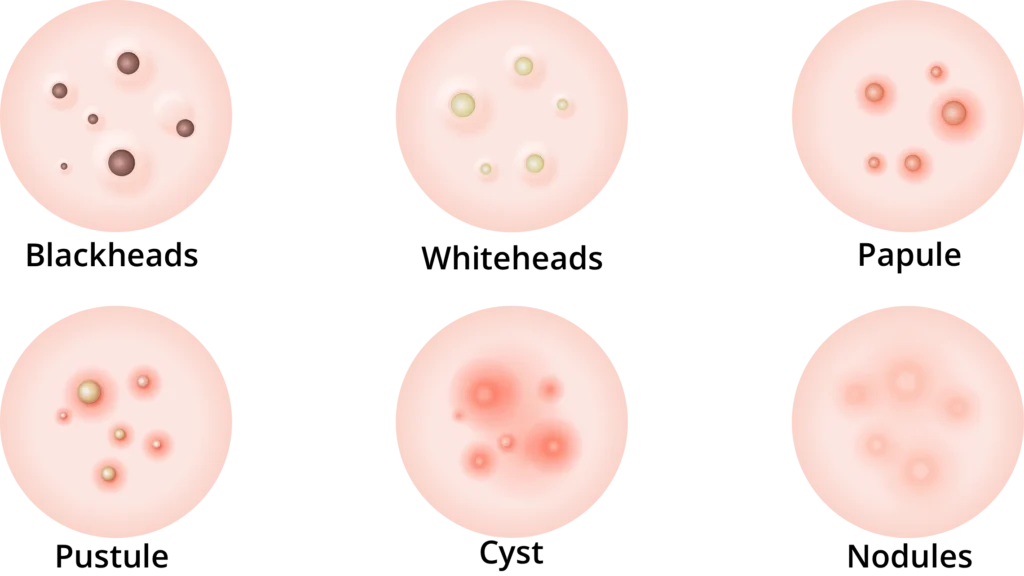
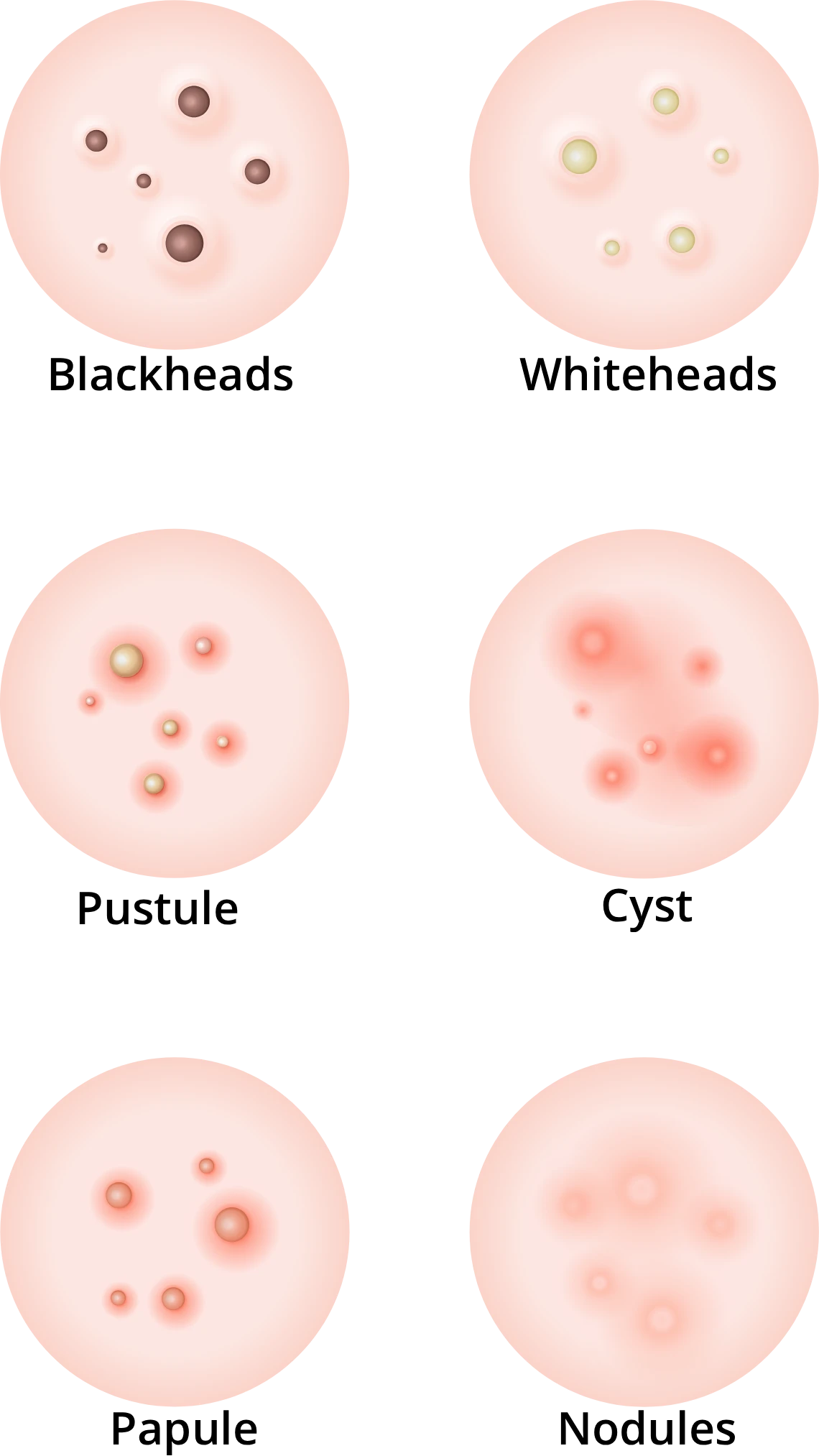
Acne happens when a pore becomes clogged with oil and dead skin cells. Depending on how deep the clog is, it can show up as:
- Whiteheads: Closed, clogged pores where oil and dead skin cells get trapped just under the surface. They look like small, flesh‑colored bumps and never fully “open” to the air.
- Blackheads: Open pores filled with oil and debris. When the material inside is exposed to air, it oxidizes and turns dark—it’s not dirt, just chemistry.
- Papules: Small, firm, inflamed bumps that feel tender to the touch. They don’t contain visible pus and often signal early inflammation inside the pore.
- Pustules: Papules that have developed a soft, white, or yellow tip. That “whitehead” is a mix of oil, dead skin cells, and immune cells responding to inflammation.
- Nodules: Large, painful lumps deep under the skin. They form when inflammation spreads below the surface and can take weeks to resolve.
- Cysts: Deep, fluid‑filled breakouts caused by severe inflammation. They’re often tender, slow‑healing, and carry the highest risk of scarring.
These usually appear on the face, chest, back, and shoulders—areas with the most oil (sebaceous) glands.
🧬 What Causes Acne
According to the Mayo Clinic, acne is driven by four primary biological factors [1]:
- Excess oil (sebum) production
- Hair follicles clogged by oil and dead skin cells
- Bacterial overgrowth (Cutibacterium acnes)
- Inflammation
But real life complicates things. Genetics, stress, hormonal shifts, irritating products, heavy friction from clothing, specific medications, and the wrong makeup can cause the skin to turn on the warning lights, letting you know something needs attention.
The Modern Realization: Acne is fundamentally a symptom of a disrupted skin barrier. Healing it requires more than just finding a strong cleanser or blasting your face with harsh acne treatments that dry out the skin and trigger a rebound oil flare-up.
🔍 The Root Cause & Solution Guide
Before stripping back your routine, look at the specific traits of your breakouts. Match your symptoms to the most likely trigger below, and apply the immediate fix.
1. Products Most Likely to Trigger a Flare-Up
These are some of the most common reasons a routine suddenly stops working or starts causing bumps.
Water‑Based Products (Creams, Gels, Toners, Serums)
- Concern: These formulas often contain long ingredient lists, making it harder to pinpoint what’s causing irritation. During a reset, avoid all water‑based products — even gentle ones — so your skin can calm down and show you what’s really going on.
- Symptom: Sudden clusters of tiny bumps, redness, or irritation that appear shortly after application.
- Solution: Throw out old batches. If it’s a DIY product, verify your preservative percentage, measure the pH carefully, and start with a minimalist base formula before adding active botanicals.
Pore‑Clogging Oils or Butters
- Concern: Some plant oils are simply too heavy or rich for acne‑prone skin, trapping debris inside the hair follicle.
- Symptom: Whiteheads, blackheads, or a gritty, congested texture under the skin.
- Solution: Switch to non-comedogenic, acne-safe oils (such as high-linoleic oils or light Meadowfoam oil) that support the barrier without blocking pores.
The Wrong Makeup or Dirty Tools
- Concern: Reused sponges and unwashed brushes harbor acne-causing bacteria.
- Symptom: Breakouts that match the exact pattern of where your makeup is applied.
- Solution: Deep-clean brushes and sponges weekly, never share cosmetics, and replace expired products. The safest makeup for acne sufferers is a mineral-based powder formula. The natural minerals are less likely to clog pores. Powder foundations also have far fewer ingredients than liquid or cream foundations, reducing the likelihood that something in the product will cause breakouts. Mineral powder foundations made with zinc oxide and titanium dioxide also provide additional sun protection. If you wear makeup, go deeper with my article “Does Makeup Cause Acne?”
Incorrect or Strong Essential Oil or Synthetic Fragrance Use
- Concern: Strong essential oils or synthetic fragrance blends can irritate sensitive or acne‑prone skin.
- Symptom: Persistent redness, itching, burning, or rash‑like bumps.
- Solution: Use fragrance-free products until your skin barrier normalizes.
2. Skincare Habits & Physical Friction
Over‑Stripping the Skin
- Concern: Harsh acne cleansers, frequent physical scrubs, or hot water can remove your natural lipid layer and trigger a “boomerang effect” in which your skin panics and overproduces heavy sebum to protect itself.
- Symptom: Increased dryness or extreme oiliness, a tight “shiny” forehead, and breakouts that worsen after using standard acne treatments.
- Solution: Ditch foaming cleansers and harsh scrubs. Switch to a gentle double-cleansing method using a soothing oil cleanser followed by a non-foaming hydrating cleanser.
Friction and Occlusion
- Concern: Physical boundaries trap heat, sweat, and bacteria against your skin barrier.
- Symptom: Breakouts along waistbands, bra straps, helmet lines, or mask areas (“maskne”).
- Solution: Wear loose, breathable fabrics. Cleanse the skin with a gentle hydrating cleanser immediately after sweating, and rotate your pillowcase at least once a week.
3. Blackheads and Facial Masks
Blackheads form when excess oil and dead skin cells accumulate and oxidize at the surface of an open pore. To manage them safely:
Use a Gentle Clay Mask
- Concern: Excess sebum on the skin surface can create an environment that encourages the growth of acne bacteria.
- Symptom: Visible blackheads or persistent surface congestion.
- Solution: Acne-prone skin can benefit from applying sebum-diminishing ingredients like kaolin clay or illite, which gently remove impurities without over-drying. However, some clays, such as Bentonite and Fuller’s Earth, can be too drying. Do not scrub the skin or use harsh exfoliating products. Whatever we put on our skin should be gentle.
Aggressive Squeezing or Picking
- Concern: Squeezing or picking can injure the skin and push the clog deeper, leading to bigger, more painful bumps.
- Symptom: Worsening inflammation or deeper, painful bumps after picking.
- Solution: Use warm compresses to naturally soften pore debris, or use occasional surface pore strips. Never aggressively squeeze your skin.
4. Internal & Environmental Triggers
Stress and Poor Sleep
- Concern: Both elevate cortisol, a hormone that directly triggers your oil glands to go into overdrive.
- Symptom: Excess oil production, systemic inflammation, and slow-healing blemishes.
- Solution: Rotate your pillow daily and change your pillowcase at least once a week to stop bacteria from cycling back onto your face. Prioritize stress-reduction habits. Skincare alone cannot overcome internal cortisol spikes.
Diet‑related inflammation
- Concern: Your daily diet can influence how easily your skin becomes inflamed, and some foods make that response stronger than others.
- Symptom: Redness, sensitivity, or more frequent breakouts.
- Solution: Eat a balanced diet rich in clean, anti-inflammatory whole foods. For a deep look at what to add to your plate, see my complete guide on The Best Foods for Clear Skin.
Hormones and genetics
- Concern: These determine how active your oil glands are and how easily your pores clog. Some people have skin that reacts more strongly to everyday stressors.
- Symptom: Recurring breakouts that follow predictable patterns.
- Solution: You may need to pay closer attention to your overall health.
If these patterns look familiar, the next step is confirming that what you’re seeing is truly acne — because several conditions can look almost identical at first glance.
The Great Imposter: Fungal Acne vs. Regular Acne
What you’re seeing may not be acne at all. If your bumps aren’t responding to treatment, you might be using the wrong routine to address the wrong problem. If you aren’t sure, read my guide on Fungal Acne vs Regular Acne before altering your routine. Once you’ve ruled out fungal acne and other look‑alike conditions, you can move on to identifying which products or habits are triggering your breakouts.
🧪 Find Your Triggers: The Acne Product Elimination Method
Once you’ve confirmed that your breakouts are regular acne, the next step is identifying which products or habits are triggering them. This method uses a short, structured reset to help you determine whether your breakouts are caused by irritation, product imbalance, or something else.
The process works in two phases: first you reset your routine, then you reintroduce products one at a time to pinpoint the trigger.
Step 1: Reset Your Routine (3–5 Days)
For the next few days, switch to a strict, minimalist routine so your skin can calm down and show you what’s really going on. Use only the following:
- An oil cleanser with an emulsifier for easy rinsing (MCT Oil‑based if your issue might be fungal-related)
- Meadowfoam or Jojoba Oil as your moisturizer (or MCT Oil if you’re fungal‑prone)
- A simple, mineral‑based sunscreen in a silicone fluid base.
If you need makeup, stick to mineral powders or lightweight silicone‑based formulas that won’t feed bacteria or degrade on the skin.
Step 2: Reintroduce One Product at a Time
Once your skin has calmed and stabilized during the reset phase, you can begin reintroducing products to identify the exact trigger. Introduce your old products back into your routine one at a time, and do not add a new product until you’ve finished evaluating the previous one. Use each product for 2–3 days on one side of your face, while keeping the reset routine on the other side, so you can clearly see how your skin responds:
- Tiny, surface-level bumps: Usually a sign of structural irritation, pH drift, or product contamination.
- Deep, painful pimples: Typically triggered by underlying inflammation or friction.
- Breakouts within 24 hours: Points to an acute ingredient sensitivity.
- Breakouts after 2–3 weeks of a DIY product: Indicate an unstable batch (preservative failure or oxidation).
Interpreting Your Results
After testing each item, you’ll fall into one of three outcomes:
- A commercial product caused the breakout:
Troubleshooting commercial formulas is difficult because they contain long ingredient lists and complex combinations of actives. The simplest solution is to stop using it and avoid similar formats for now (heavy creams, multi‑active serums, fragranced products). - A DIY product caused the breakout:
Make a fresh batch, sanitize your tools, and simplify the formula before adding extras. If it was a water‑based DIY product, unstable batches are common — double‑check your preservative and pH when remaking. - No product seems to be the trigger:
If everything you reintroduced was tolerated, your breakouts may be driven by habits, friction, stress, hormones, or internal inflammation rather than a specific product. In that case, keep the routine simple and focus on consistency, barrier repair, and reducing known triggers such as over‑cleansing, tight clothing, or poor sleep. To dive deeper on skin barrier repair, see my article How to Build a Healthy Skin Barrier.
Once you understand how your skin responded — whether a product was involved or not — you can rebuild your routine using product formats that support your skin barrier instead of overwhelming it.
🛒 The Acne-Safe Shopping List: Product Formats
When your skin is breaking out, your goal should be to support your skin’s natural microbiome and keep your skin barrier intact. When shopping for products or formulating your own, look for these specific formats designed to clear pores without removing your skin’s natural oils. The products listed below come from the recipes in Simple DIY Skincare, but you can follow the same steps using comparable products you already own.
Gentle Cleansers
- Oil Cleanser: Your essential first step at night. A non‑comedogenic oil cleanser binds to and dissolves hardened sebum, synthetic sunscreens, and stubborn makeup, lifting them away effortlessly without disrupting your natural moisture balance. Because oil dissolves oil, it reaches into clogged pores more effectively than water‑based cleansers, softening buildup so it can rinse away without scrubbing or stripping the skin.
- Hydrating Cleanser: A non-foaming, water-based leave-on wash that gently cleanses while depositing water-binding nutrients into the skin. It removes invisible microbiome disruptors without leaving your face feeling tight, dry, or stripped.
- Skip Heavy Foaming Agents: If a cleanser creates a mountain of bubbles, it likely contains harsh surfactants that raise the skin’s pH and strip your lipid “mortar,” triggering a rebound oil flare-up.
Active Repair
Once your cleansing steps are in place, you can layer in targeted treatments that address inflammation, congestion, and barrier repair more directly.
- Super Serum: A lightweight, oil-free fluid that delivers concentrated, customizable active ingredients deep into the skin cells before you seal in moisture. It’s perfect for addressing redness, pigmentation, or barrier damage.
- Manuka Mud Treatment Mask: A multi-corrective, purifying clay treatment designed to balance surface oils and smooth skin texture without drying. Unlike typical stripping clay masks, this formula pairs oil-absorbing Kaolin clay with 13% Manuka Honey Extract and 4% Colloidal Oatmeal to intensely condition and calm active redness, making it exceptionally safe for sensitive, breakout-prone barriers.
- Barrier Repair Cream: After addressing surface congestion and inflammation, the next step is reinforcing your skin barrier with a moisturizer designed to restore structure and resilience. While conventional advice says to avoid plant butters if you have breakouts, specialized creams can safely utilize deeply healing, non-comedogenic options like Mango Butter at targeted percentages. When balanced with lightweight, stable emollient oils (like Meadowfoam oil) and natural skin-hydrators (like Sodium PCA), it feeds the lipid barrier exactly what it needs to repair itself without congesting your pores.
Moisture Sealants
Once your barrier is supported with a proper moisturizer, you can finish your routine with lightweight nourishing sealants.
- High-Linoleic Face Oils: Acne-prone skin often lacks linoleic acid, so its natural sebum is thick and sticky. Applying lightweight, high-linoleic plant oils thins out your natural sebum, protecting the barrier while keeping pores clear. Check Plant Oils for Skin Care to confirm if an oil is recommended for acne-prone skin.
Spot Care
For daytime or early‑stage bumps, start with Zit Zap Spot Stick. For overnight or irritated spots, start with Barrier Ointment. Use the others based on how the spot looks and feels.
Cosmetics & Sun Protection
After finishing your skincare layers, the final step is choosing makeup and sun protection that won’t interfere with healing.
- Mineral Sunscreen: This is the final required step of skincare. Apply it after moisturizer and before any makeup, and allow it to absorb for 1–3 minutes so the mineral layer can set evenly. Mineral formulas containing zinc oxide and titanium dioxide in a silicone fluid offer the most reliable UV protection for acne‑prone or sensitized skin. The following items in this section are optional.
- Mineral Powder Foundation: The safest makeup option for acne‑prone skin. Minimal‑ingredient mineral formulas are far less likely to clog pores or trigger irritation than traditional liquid foundations. They also add a gentle boost of physical sun protection, but should be used as a supplement to—not a replacement for—your sunscreen.
- Silicone-Based Makeup Bases & Primers: Cosmetic‑grade silicones are non‑comedogenic, non‑reactive, and chemically stable. They create a silky, breathable lattice over compromised skin, smoothing texture and preventing liquid pigments or external bacteria from settling directly into pores. Apply only to clean skin to avoid trapping bacteria.
- Mattifying Face Powder: A clean, mineral‑based powder that absorbs excess shine, blurs enlarged pores, and supports a clear complexion without drying the living skin underneath. The mineral pigments also add a light layer of extra UV scatter on top of your sunscreen.
🧪 Skincare Ingredients to Embrace
With your routine structure in place, the next step is choosing ingredients that actively support healing and keep your barrier strong. To clear acne and rebuild a broken barrier, you need ingredients that calm overactive oil production, fight inflammation, and keep the pore lining clear without causing structural damage.
Barrier Protectors & Brighteners
These calm structural irritation and strengthen the skin’s defense systems, lock in deep moisture, and help fade stubborn post-breakout dark marks (PIH).
- Ingredients to look for: Niacinamide (Vitamin B3), Squalane, Ceramide Complex, Sodium PCA, and Kojic Acid Dipalmitate (KAD).
Formulator’s Tip: Unlike standard water-soluble Kojic Acid, which is highly unstable and quickly turns brown in the bottle, KAD is a stable, oil-soluble ester. It blends perfectly into facial oils and balms, making it ideal for fading hyperpigmentation without destabilizing your formula or irritating sensitive skin.
Pore Purifiers & Sebum Balancers
These gently lift excess surface debris, break apart yeast films, and help keep the environment inside the hair follicle balanced.
- Ingredients to look for: Kaolin Clay, Illite, Alpha Arbutin (excellent for clearing post-acne marks), Xylitol (included at a powerful 10% in targeted treatments to actively break down stubborn yeast biofilms), and safe, highly diluted targeted botanicals like Manuka Honey Extract.
Soothing & Anti-Inflammatory Actives
These reduce the redness, painful swelling, and deep heat associated with papules, pustules, and active blemishes.
- Ingredients to look for: Bisabolol, Colloidal Oatmeal, Probacillus Revive, and Copaiba Oil.
⚠️ Skincare Ingredients to Avoid
Just as certain ingredients can support healing, others can slow your progress or trigger new irritation. If you are actively trying to break a cycle of chronic breakouts and repair a damaged barrier, temporarily step away from these stripping or clogging ingredients:
- Harsh Surfactants: High-pH bar soaps and heavy foaming agents that leave your skin feeling squeaky clean (a sure sign your barrier has been stripped).
- Pore-Clogging Heavy Lipids: Highly comedogenic plant butters (like Cocoa Butter or Wheat Germ Oil) that form a heavy, suffocating film and trap dead skin cells inside the follicle.
- Sensitizers: Strong, undiluted essential oils and synthetic fragrances (“fragrance” or “parfum”), which cause contact irritation that mimics or worsens acne.
- Drying Acids & Overused Actives: Aggressive daily use of Salicylic Acid, Benzoyl Peroxide, or strong prescription retinoids when your skin is already red, flaky, or inflamed. If you’re using a prescription retinoid, pause only temporarily during barrier repair, then reintroduce it slowly once your skin is stable.
- Occlusive Waxes & Film‑Formers: Heavy waxes and dense film‑formers that trap heat and sweat during an active breakout.
🩹 The Aftermath: Fading Acne Scars (PIH vs. PIE)
Once active breakouts are under control, you can shift your focus to the marks they leave behind. Knowing what kind of mark you have changes how you treat it:
📚 Next Steps: Your Healing Path
With a clear understanding of the type of marks you’re treating, you can choose the most effective path forward. With the basics in place, here’s how to move forward in a structured, sustainable way.
- Start with a good skincare routine: Give your skin a chance to heal! Using a consistent skincare routine for acne for several months can significantly improve your skin’s overall health and appearance and reduce the likelihood of future breakouts.
- Spot treatment can help: Spot care can help calm inflammation and prevent marks from worsening. Refer back to the Spot Treatment section above to choose the option that best matches what your skin is doing.
- Take a holistic approach: Skin doesn’t heal in isolation. Support recovery by improving sleep, managing stress, reducing friction on the skin, and eating skin-friendly anti-inflammatory foods. These habits help regulate inflammation and make your topical routine more effective.
⏳ Timeline: How Long Does It Take to Heal Skin Barrier Acne?
Your skin barrier doesn’t heal overnight. Even when you’re doing everything right, improvement follows a predictable pattern:
- Immediate changes (3–5 days): Redness softens, surface irritation calms, and new breakouts slow down as inflammation drops.
- Visible clarity (2–4 weeks): Pores look smoother, active acne becomes less frequent, and your skin stops cycling through constant flare‑ups.
- Pigment fading (6–12 weeks): PIH gradually lightens with consistent barrier support and sun protection.
- Deep recovery (3–6 months): PIE redness fades, texture evens out, and the barrier becomes more resilient to future triggers.
Healing isn’t linear. You may have small flare‑ups along the way, but the overall trend should be calmer, clearer, and more predictable skin. Clear skin isn’t about harsher treatments — it’s about restoring balance, protecting your barrier, and understanding what your skin is trying to tell you.
📖 Take Control of Your Skin’s Ecosystem
Once you’ve stabilized your routine and understand what your skin needs, you can go deeper and start creating formulas tailored to your own skin barrier.
In my book, Simple DIY Skincare: The Complete Guide to Easy, Natural Recipes for Beginners, I give beginners the knowledge to create gentle, balanced skincare from scratch that works with your skin’s natural microbiome.
📑 References
- Mayo Clinic. “Acne – Symptoms and causes.”
mayoclinic.org/diseases-conditions/acne/symptoms-causes/syc-20368047.
↩ - Neukam, K., De Spirt, S., Stahl, W., Bejot, M., Maurette, J.-M., Tronnier, H., Heinrich, U. “Supplementation of Flaxseed Oil Diminishes Skin Sensitivity and Improves Skin Barrier Function and Condition.” Skin Pharmacol Physiol, 2011; 24 (2): 67–74.
↩